
GPR Scanning and Private Utility Locating in Seattle: Wet Ground, Tight Sites, and Side Sewers

Seattle jobs usually present two problems at once. The site is small and crowded, so there is no margin for error. The ground is wet, which limits some locating methods. We work throughout King and Snohomish counties, from downtown concrete scanning to residential side sewer locates in Ballard. Here is how we handle both.
The side sewer problem
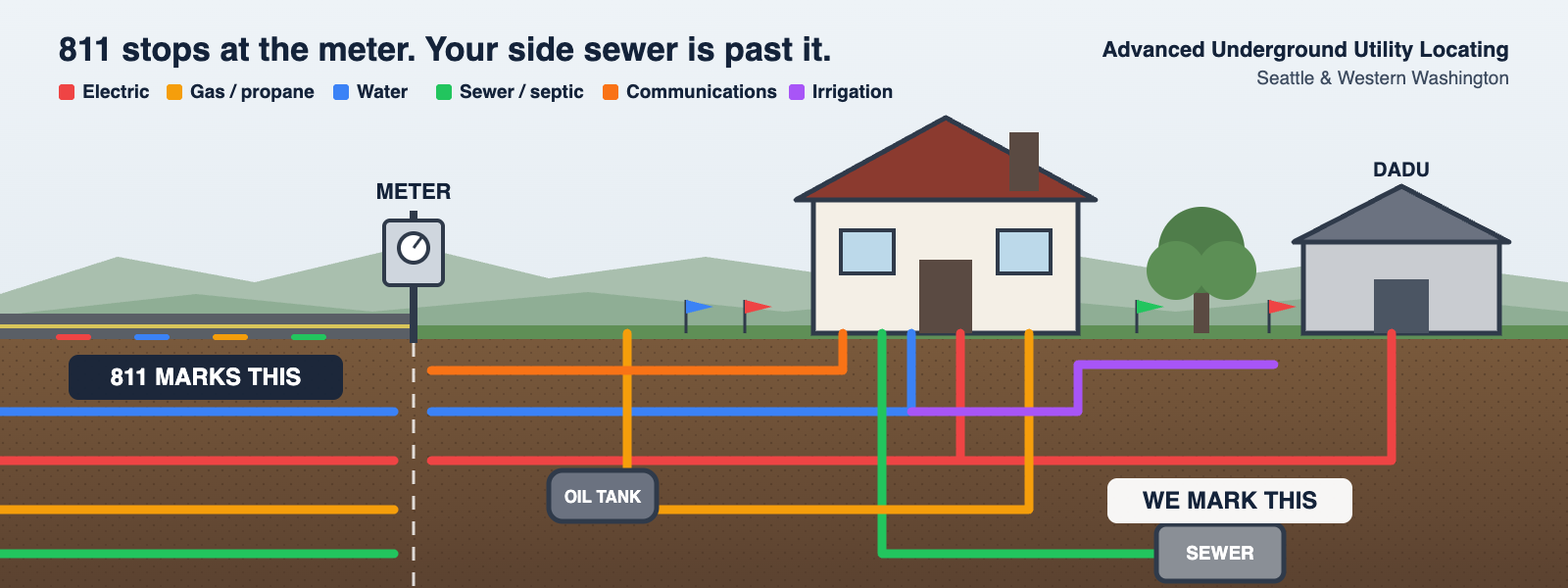
Seattle calls the private sewer line a side sewer. It is the single most common line we are asked to find. It runs from the house to the city main, it is the owner's responsibility from the house to the property line and often beyond, and the city does not mark it. On older lots it may be concrete or clay. It may run under the neighbor's yard. It may have been rerouted during an unpermitted remodel. Before you replace a driveway, add a foundation, or plant a hedge, you will want to know where it actually is. We use our equipment to find its path, so there is no guesswork.
What 811 does not cover on a Seattle lot
Side sewers and private storm drains
Water service from the meter to the house
Power and communication feeds to garages, DADUs, and basement units
Irrigation and low voltage lighting
Abandoned oil tank fill lines (common in older Seattle homes)
Anything under a slab, in a parking structure, or inside a building
That last item accounts for much of our commercial work.
Concrete scanning on commercial sites
Coring or cutting a slab in an occupied building means going through whatever is embedded in it: rebar, post-tension cables, conduit, and radiant tubing. Ground penetrating radar shows what is there before the saw does. We scan the cut area, mark the targets on the surface, and give you a clear zone to work in. This is routine for tenant improvements, anchor installs, and mechanical work in Seattle, Bellevue, and Everett. It costs far less than repairing a cut post-tension cable.
Wet soil and what it means for the locate
Western Washington ground holds water, and glacial till is dense and mixed. GPR depth and clarity drop in saturated soil, so we do not rely on it alone. Electromagnetic locating is our first tool for anything metallic or anything we can put a signal on. We use GPR where it adds information, especially for plastic pipe and disturbed soil. Some lines are easier to find in August than in February, and we will tell you when a reading is less certain than we would like.
Scheduling in Seattle and Western Washington
Our Western Washington office covers Seattle, Bellevue, Redmond, Everett, Lynnwood, Renton, Kent, and the Eastside. Send the address, a description of the work, and any drawings you have. Contractors and property managers with recurring work can set up an account and book directly.
Comments